Categories/Tags Methodology
Last updated: October 2, 2026
On CoinGecko, we use two distinct types of tags to help users discover and filter assets. Before submitting a request, please ensure you are asking for the correct type:
Important Note on Tag Types:
- Chains/Ecosystem Tags (e.g., Bitcoin Ecosystem, Ethereum Ecosystem, Solana Ecosystem) are assigned automatically when the relevant contract address is added to your token. If you need an ecosystem tag, please submit a Contract Address Addition request instead.
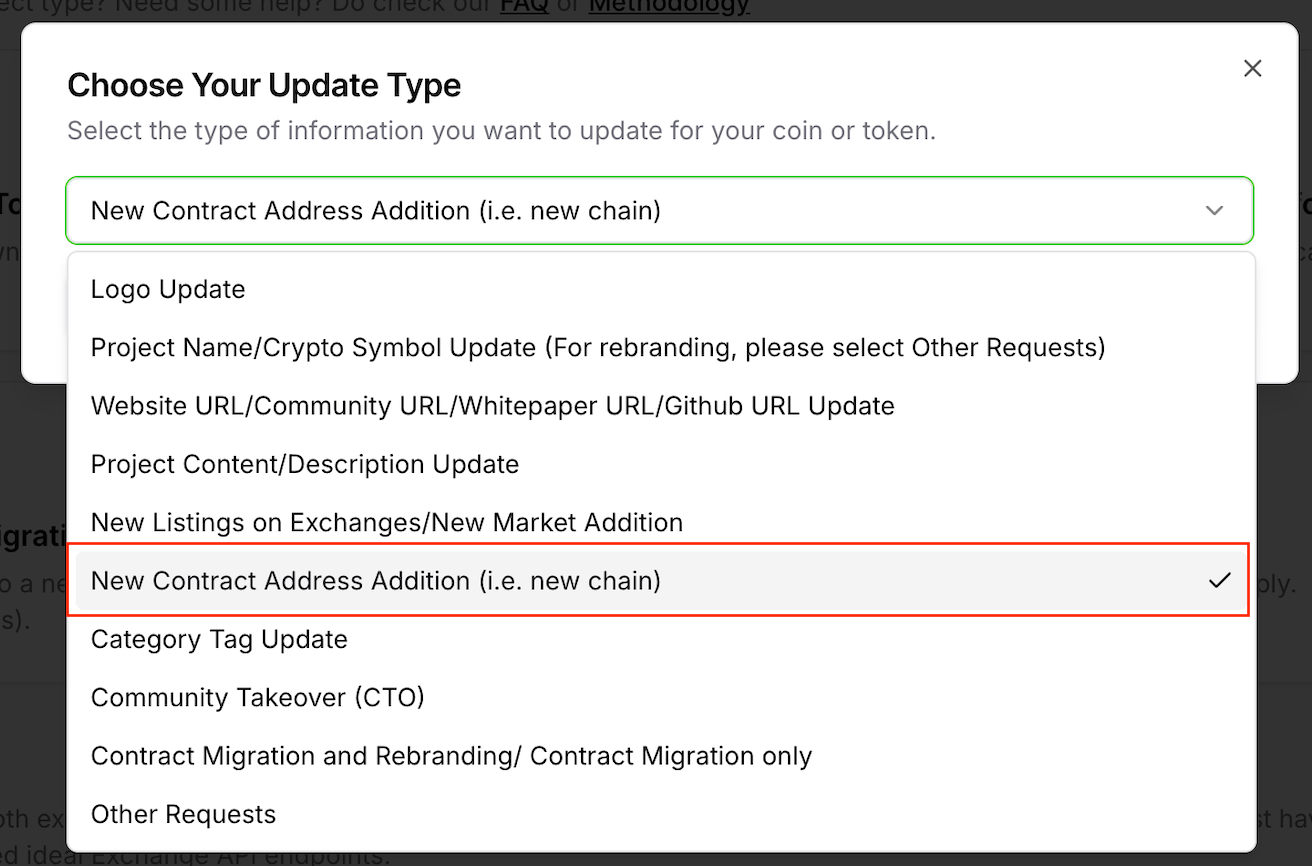
- Category Tags (e.g., AI, DeFi, RWA, NFT, Gaming) are market labels that you can manually request to be added to your token's page.
When submitting your request, please provide insights on how your project fits into the requested category. For example, if you are requesting the "DeFi" category for your token page, please provide supported evidence of your project fitting into DeFi.
Click here to apply for the Category tag update, and refer to this guide [How to Add Categories or Tags to Your Token] for further information on how to use the form.
General Tagging Guidelines
- Relevance: The requested tag should directly relate to the main function or technology of the project.
- Operational Products: Projects must have a minimum viable product (MVP) that demonstrates its functionality.
- Generic blockchain platforms and infrastructure projects should not be tagged into many categories, e.g., DeFi, AI, RWA, as this may lead to confusion and dilute the specific contexts these tags are meant to represent.
Note:
These guidelines provide a framework but do not guarantee approval. Category tags and criteria are subject to periodic review following CoinGecko’s internal evaluation methodologies and industry narratives.
Sector Specific Tagging Guidelines
Artificial Intelligence (AI)
- Criteria: Projects must focus on developing or utilizing AI technologies. Projects should contribute to the advancement of AI technology or its application.
- Exclusions:
- Blockchains (e.g., Layer 1/2) unless wholly AI-focused.
- Claims of partnerships with AI-tagged projects are made only if AI criteria are independently met.
- Projects that merely outline AI concepts in a whitepaper or roadmap without a functioning Minimum Viable Product (MVP) do not qualify.
- Examples of Qualifying Project:
- A decentralized network where AI models can interact and share information, training collaboratively to improve and evolve together, leveraging blockchain to secure the models and their interactions.
- A platform that allows anyone to create, share, and monetize AI services at scale.
Decentralized Finance (DeFi)
- Criteria: Projects must involve DeFi functions such as swapping, liquidity provision, derivative trading, or token minting/burning.
- Exclusions:
- DeFi tags are not assigned to Blockchains (e.g., Layer 1/2) unless they are DeFi-focused chains.
- Example of a Qualifying Project:
- A decentralized platform that offers automated yield farming tools and a governance token allowing users to vote on protocol upgrades and pool additions.
Real-World Assets (RWA)
- Criteria: Projects eligible for the RWA category must directly involve or be backed by physical or traditional financial assets. This includes, but is not limited to, currencies, commodities, equities, and bonds.
- Exclusions:
- Partnering with or integrating services from RWA projects does not qualify a project as RWA.
- Projects that only outline RWA integration in a whitepaper or roadmap without a functioning MVP do not qualify.
- Example of a Qualifying Project: A platform that tokenizes commercial real estate, allowing users to buy, sell, and trade fractional ownership in the form of RWA-backed tokens.
Non-Fungible Token (NFT)
- Criteria: Projects must focus primarily on NFTs, including the creation, sale, or exchange of digital assets. Platforms may include NFT minting services or marketplaces.
- Exclusions:
- Issuing NFTs for promotional purposes or using them more as accessories does not qualify as an NFT.
- Examples of Qualifying Project:
- A digital art marketplace where artists can mint, display, and sell their artwork as NFTs, with integrated smart contracts ensuring artists receive royalties from secondary sales.
- A gaming project where NFTs play a central role in the gameplay, character ownership, or in-game economy.
Gaming
- Criteria: Projects must have an MVP that is playable. The game should fundamentally incorporate blockchain technology within its gameplay mechanics.
- Exclusions:
- Games still in conceptual or early development stages without a playable version or substantial proof-of-concept do not meet the criteria.
- Example of a Qualifying Project: A project that allows users to play and includes the use of cryptocurrencies or tokens for transactions, trading in-game assets, and rewarding players.
Note:
- Just because a tag has been assigned on other data aggregator platforms does not automatically qualify a project for the same tag on our platform. Each application is evaluated on its own merits according to our specific criteria.
- Our classification methodology may evolve over time to better align with industry narratives and developments. We may review the list (remove/add) to ensure relevancy/compliance with the new methodology.
Need Help?
If you have further questions or encounter issues during the submission process, please submit a ticket at our Support Center.